 Image 1 of 1
6.50 × 2.875 in
Hand-cut International Currency Collage on Archival Paper
This piece started out with one colorful constraint in mind: Yellow. In numismatics, yellow is without the doubt the rarest colors to find heavily used. On banknotes, it’s the lightest color and gets dirty the fastest. It shows immediate wear, and historically hasn’t been practical to rely on. Even with the introduction of polymer notes, yellow is still not widely used, with few countries really leaning into yellow in any dominant fashion. This inherent rarity is what inspired me to capture that essence of value and some of the ways we see it and interact with it.
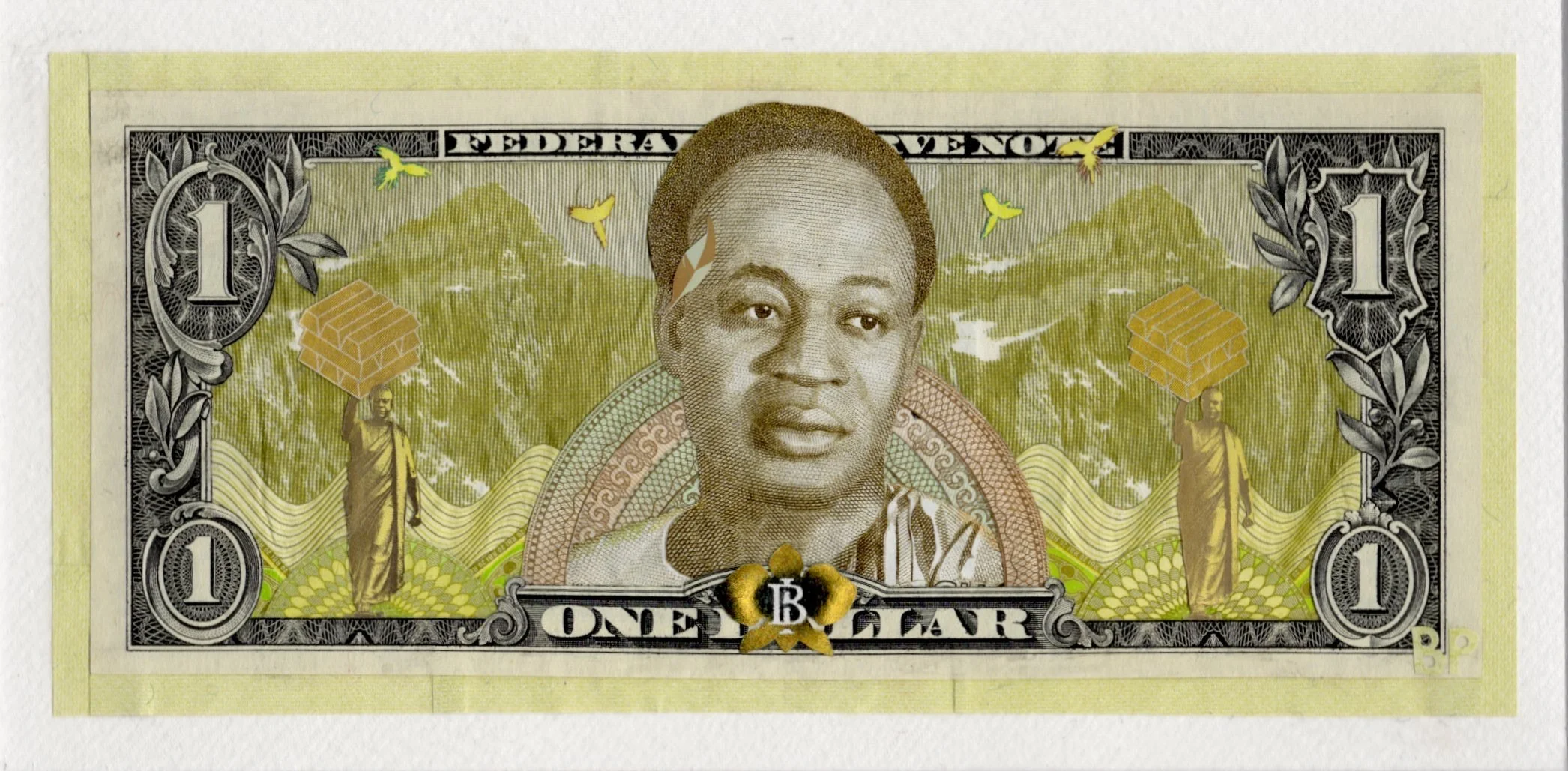
The centerpiece of this work is a large portrait of Dr. Kwame Nkrumah, from Ghana’s 2017 Commemorative 2 Cedis note. He’s seen looking off into the distance, seemingly disconnected, with an expression that feels almost removed. Present, but not truly there. An ambiguous amalgamation of emotions that leaves the holder curious of his thoughts and feelings.
One of my favorite components, a distinctly shimmering stack of gold bars, sits in the same note as Nkrumah. Nine individual bars make up this single block, of which I carved two to sit equidistant from the center figured Nkrumah. They are held up by his statues, the gold held up above them. It reads like reverence, but also weight, as if they are bound to carry something they cannot actually control. Placed to either side of our center figure, these reimagined statues create a sense of grounding symmetry, almost pinning our figure in place. Though Nkrumah stands tall in the center, he is not free within it. He is seen framed, contained by the circular insignias of the Kyrgyzstan Tyiyn, which start to feel less decorative and more like golden shackles of a system that contains him in his place.
Behind our ground level is open space with the highest mountain in Slovenia, Triglav in the Julian Alps. The range stretches far back and out, creating a sense of distance that you can never truly reach. Above them, from Madagascar, two birds in flight to either side. The only components in this piece with a sense of movement, the birds are notably not bound to anything, not structured, and free to just: leave.
There is an unsettling contrast between the statues, tied down with heavy bricks of gold, while the birds exist above that system entirely. Nkrumah sits caught between, he looks longingly at the birds free from constraint, his tucked feather a continuous reminder of his ideas for freedom.
When even the rarest things are cut, cultivated, and put on display, what makes you think your freedom isn’t being constructed the same way?
6.50 × 2.875 in
Hand-cut International Currency Collage on Archival Paper
This piece started out with one colorful constraint in mind: Yellow. In numismatics, yellow is without the doubt the rarest colors to find heavily used. On banknotes, it’s the lightest color and gets dirty the fastest. It shows immediate wear, and historically hasn’t been practical to rely on. Even with the introduction of polymer notes, yellow is still not widely used, with few countries really leaning into yellow in any dominant fashion. This inherent rarity is what inspired me to capture that essence of value and some of the ways we see it and interact with it.
The centerpiece of this work is a large portrait of Dr. Kwame Nkrumah, from Ghana’s 2017 Commemorative 2 Cedis note. He’s seen looking off into the distance, seemingly disconnected, with an expression that feels almost removed. Present, but not truly there. An ambiguous amalgamation of emotions that leaves the holder curious of his thoughts and feelings.
One of my favorite components, a distinctly shimmering stack of gold bars, sits in the same note as Nkrumah. Nine individual bars make up this single block, of which I carved two to sit equidistant from the center figured Nkrumah. They are held up by his statues, the gold held up above them. It reads like reverence, but also weight, as if they are bound to carry something they cannot actually control. Placed to either side of our center figure, these reimagined statues create a sense of grounding symmetry, almost pinning our figure in place. Though Nkrumah stands tall in the center, he is not free within it. He is seen framed, contained by the circular insignias of the Kyrgyzstan Tyiyn, which start to feel less decorative and more like golden shackles of a system that contains him in his place.
Behind our ground level is open space with the highest mountain in Slovenia, Triglav in the Julian Alps. The range stretches far back and out, creating a sense of distance that you can never truly reach. Above them, from Madagascar, two birds in flight to either side. The only components in this piece with a sense of movement, the birds are notably not bound to anything, not structured, and free to just: leave.
There is an unsettling contrast between the statues, tied down with heavy bricks of gold, while the birds exist above that system entirely. Nkrumah sits caught between, he looks longingly at the birds free from constraint, his tucked feather a continuous reminder of his ideas for freedom.
When even the rarest things are cut, cultivated, and put on display, what makes you think your freedom isn’t being constructed the same way?